
Qingdao Smart Navigation Advances Autonomous Shipping through Continuous Upgrades to Smart Vessels
Qingdao Smart Navigation Develops Zhi Fei, China’s First Smart-Driving Container Ship Designed for Commercial Operations
Jiang Haiying, Chairman of Smart Navigation (Qingdao) Technology Co., Ltd.:
Ships Are Moving toward Autonomous Navigation
Ships are evolving from “passive piloting” toward autonomous navigation, while the shipping industry is entering a new stage driven by technological transformation. Having worked in the field of intelligent shipping for many years, we have collaborated with national-level research institutes to tackle key technological challenges, developed a differentiated and independently controlled technical pathway, and addressed gaps in China’s technologies for large commercial smart ships. Through these efforts, we aim to support the standardized and large-scale development of China’s intelligent shipping industry.
China’s intelligent shipping sector has now entered a new stage of systematic advancement, and its sustainable development will require the participation of more stakeholders. We hope to cooperate with more research institutes and upstream and downstream enterprises, deepen collaboration in data sharing, scenario testing, and technology implementation, and jointly build a more complete intelligent shipping ecosystem. By leveraging Qingdao’s strengths in the marine economy, we aim to gather industrial momentum and contribute more of Qingdao’s scientific and technological innovation capacity to the development of China as a strong transportation and maritime nation.
Without a crew member at the helm or a human manually steering the vessel, a giant ship sails across the sea equipped with intelligent perception and decision-making systems. Like a vessel with “intelligent eyes” and a highly capable “smart brain,” it can follow a planned route autonomously and berth precisely at a terminal. Unmanned shipping scenarios that once existed only in science fiction have now become a reality in the waters of Qingdao.
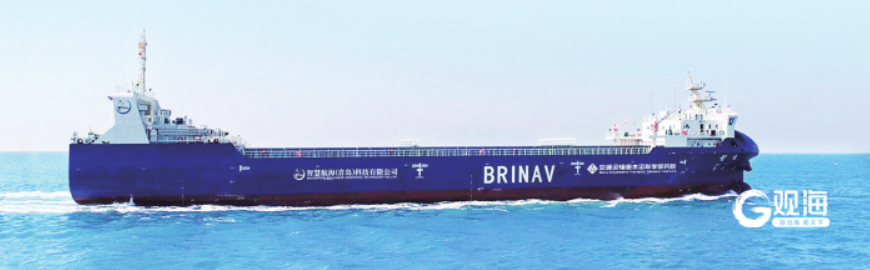
Developed independently by Smart Navigation (Qingdao) Technology Co., Ltd., referred to hereafter as Qingdao Smart Navigation, Zhi Fei is China’s first smart-driving container ship designed for commercial operations. It is also the largest smart-driving container ship by tonnage currently in commercial service worldwide.
In February this year, Zhi Fei worked in coordination with the automated terminal at Qingdao Port to complete China’s first fully unmanned closed-loop operation involving autonomous navigation at sea, autonomous berthing, intelligent cargo handling, and autonomous departure. This marked the country’s first unmanned ship-port coordinated operation and represented a significant achievement in the development of intelligent shipping in China.
Recently, a reporter visited Qingdao Smart Navigation’s vessel operation center in Qingdao Blue Valley. On a large electronic screen, real-time data on waves, vessel positions, navigational obstacles, and other conditions were continuously displayed. From the center, staff members could observe the movement of Zhi Fei in waters near Qingdao Port of Shandong Port Group and remotely control the vessel when necessary.
Behind the constantly changing data, a technological revolution unfolding across the blue sea is rapidly gaining momentum.
Achieving a Breakthrough from Zero to One
How was this vessel, which broke the technological monopoly of overseas suppliers and achieved China’s first commercially operated smart cargo ship, created?
The story dates back to 2016, when China’s intelligent shipping industry was still in its infancy. The Waterborne Transport Research Institute of the Ministry of Transport took the lead in launching national-level planning for intelligent shipping and research on demonstration vessels. However, many enterprises were reluctant to participate because industry standards were incomplete, commercially viable cases were lacking, and the full-cycle development, construction, and sea-trial validation of smart ships required substantial investment with a long return period.
“The traditional shipping industry faces structural shortages of seafarers and serious safety risks caused by human factors. There is an urgent need to improve the level of intelligence, and intelligent shipping has become an inevitable development trend. We also hoped to address technological gaps and provide domestically developed solutions for the industry,” said Jiang Haiying, Chairman of Qingdao Smart Navigation.
Faced with an unexplored field, the company chose to tackle the challenge and began several years of intensive technological development.
Qingdao Smart Navigation subsequently signed a strategic cooperation agreement with the institute and began advancing core technology research and development, full-scale vessel construction, and commercial implementation.
At that time, there was no mature domestic technical pathway available for reference. Moreover, data interfaces for certain imported navigation and other equipment were not open to external developers, making research and testing extremely difficult. The research team worked intensively in laboratories and at offshore test sites, repeatedly refining algorithms and modifying hardware.
After several years of technological development, the team successively launched the small experimental vessel Zhi Teng, completed basic autonomous navigation tests in coastal waters, and overcame technical challenges related to fundamental communications and radar integration.
Building on this early technological foundation, construction of Zhi Fei officially began in May 2020. The vessel was delivered and entered commercial operation in 2022.
As the demonstration vessel for the national key research and development project titled “Key Technologies for Intelligent Ship Navigation and Control Based on Ship–Shore Collaboration,” Zhi Fei has an overall length of 117.15 meters, a beam of 17.32 meters, a molded depth of 9.9 meters, and a displacement of approximately 8,000 tonnes. It has a design speed of 12 knots, a range of up to 4,500 nautical miles, and a carrying capacity of 316 twenty-foot equivalent units.
On February 21 this year, at the New Qianwan Container Terminal of Qingdao Port, Shandong Port Group, Zhi Fei operated in unmanned autonomous navigation mode and was secured at the berth by the powerful vacuum pads of a vacuum-based automatic mooring system. No crew members were required to handle mooring lines during the entire berthing process.
This marked the first time in China that a container ship had completed the full process of navigation, berthing, and port operations without human intervention.
Zhi Fei has three operating modes: manual navigation, remote-controlled navigation, and autonomous navigation. It is capable of intelligent perception and understanding of the navigational environment, autonomous route planning, intelligent collision avoidance, automatic berthing and unberthing, and remote-controlled navigation.
Through a multi-network and multi-mode communication system integrating 5G, satellite communications, and other technologies, the vessel can coordinate with ports, shipping companies, maritime authorities, navigational support institutions, and relevant facilities. Its perception accuracy reaches 99.2%, and all tested performance indicators exceed publicly available international benchmarks.
“In particular, our independently developed intelligent berthing and unberthing assistance system has broken the technological monopoly of the dynamic positioning systems commonly used internationally. While ensuring operational efficiency, it significantly reduces costs and gives us greater technological initiative in the international market,” Jiang said.
To date, Zhi Fei has completed nearly 1,500 commercial voyages, accumulated more than 50,000 nautical miles of sailing distance, and made more than 10 million autonomous system decisions. It has become a benchmark vessel with the largest operational scale and one of the most mature operating records among smart commercial ships worldwide.
Supporting the Upgrading of the Intelligent Shipping Industry
Behind the steady operation of a smart vessel lies the rapid development of the wider intelligent shipping industry.
Drawing on experience gained from full-scale vessel operations and frontline maritime data, Qingdao Smart Navigation is building a complete industrial chain covering standard formulation, technology research and development, sea trials, product implementation, and nationwide deployment.
Research and development personnel account for approximately 70% of the company’s workforce. The company has obtained more than 200 authorized patents in key areas such as intelligent ship perception, autonomous collision avoidance, route planning, ship–shore collaboration, and intelligent decision-making. Its core technologies are independently controllable, supported by a well-developed patent portfolio.
The company has also been deeply involved in national-level policy research and top-level industrial planning for intelligent shipping. It has participated throughout the development of national standards, industry standards, and group standards, and has undertaken pilot tasks under the Ministry of Transport’s “Building China into a Strong Transportation Nation” initiative and its “Pioneering Applications of Intelligent Shipping” programme.
Qingdao Smart Navigation received the Special Prize of the Science and Technology Progress Award from the China Institute of Navigation and has been recognized as a specialized, sophisticated, distinctive, and innovative small and medium-sized enterprise in Shandong Province.
In terms of technology deployment, the project “Development and Industrial Application of Key Technologies for Intelligent Ship Navigation Systems,” which incorporates the technologies used on Zhi Fei, received the First Prize of the 2024 Qingdao Science and Technology Progress Award. The related technologies have already been applied to more than 20 vessels.
The company’s intelligent navigation equipment has now been installed on vessels operating in six major types of navigational waters: ocean-going routes, offshore waters, coastal waters, river–sea routes, inland waterways, and reservoir areas.
Its systems are compatible with a wide range of mainstream vessel types, including law-enforcement and government service vessels, bulk carriers, container ships, passenger vessels, sightseeing boats, and special-purpose workboats, providing a broad range of application scenarios.
The shipping industry is accelerating its transition toward intelligent and green operations, and the continuous upgrading of smart ships has become an irreversible trend. Further improving a vessel’s “smart brain” requires the sustained support of massive volumes of high-precision navigational data.
Qingdao Smart Navigation has access to an exclusive 220-square-nautical-mile test area in the waters off Nüdao, where it can conduct comprehensive full-scale maritime simulation, navigation, and operational verification tests.
The company has also accumulated a large volume of real-world autonomous navigation data from commercial vessels. A single vessel can generate up to 1 terabyte of data per day, covering coastal routes, complex waterways, and diverse traffic scenarios. These data provide a critical foundation for algorithm iteration and model training, enabling the company to build a world-leading database of full-scale vessel operations.
“Obtaining ship navigation data is difficult. Collecting real-world data on wind, waves, currents, surges, and navigational scenarios, and converting these data into effective training datasets, is a challenge faced by the entire industry. We are now using real-world data collected from Zhi Fei and other vessels to train our models,” Jiang said.
The company is planning to establish four regional data centers, each focusing on data from different types of waters and vessels, including inland waterways, coastal waters, and ocean-going routes, with the aim of accelerating the commercial operation of data assets.
In February this year, the Ministry of Transport, the Ministry of Industry and Information Technology, the State-owned Assets Supervision and Administration Commission of the State Council, and the State Administration for Market Regulation jointly issued the Intelligent Shipping 2030 Action Plan, which calls for accelerated research and development of smart ship technologies and equipment.
As one of the principal suppliers of intelligent navigation systems for China’s national intelligent shipping demonstration vessels, Qingdao Smart Navigation is undertaking supporting tasks for national-level intelligent shipping demonstration projects.
Looking ahead, the company will seize the opportunities created by the construction of demonstration vessels, further develop its presence in the Pinglu Canal, the Yangtze River, and the Yellow Sea and Bohai Sea markets, implement major contracted projects, accelerate regional joint-venture development, and promote the high-quality growth of the industry. Through these efforts, it aims to contribute more to China’s development as a strong transportation and maritime nation.
Reporter: Dou Yanfeng
Source: Qingdao Daily / GuanHai News
Link: https://www.dailyqd.com/guanhai/460142_1.html?