
Bureau Veritas Supports Wind-Assisted Aframax Tanker ALBERT PARK, Advancing Green Shipping Technologies
Bureau Veritas Marine & Offshore (BV) has announced the successful naming of ALBERT PARK, a 114,000-deadweight-tonne wind-assisted Aframax product tanker owned by UK-based Union Maritime. The vessel was built by Yangzhou COSCO Shipping Heavy Industry in China and officially named in September 2026, marking another important milestone in the commercial application of wind-assisted propulsion technology.
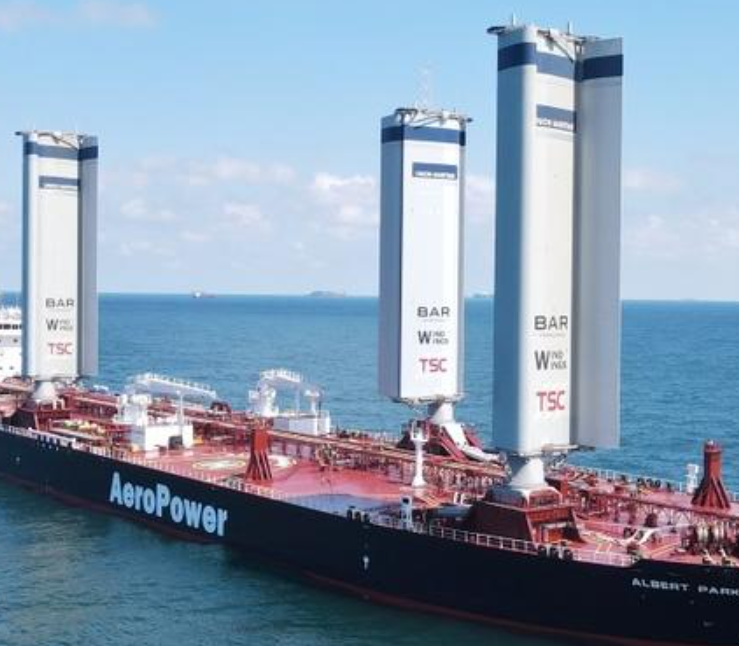
As the first wind-assisted Aframax product tanker constructed by Yangzhou COSCO Shipping Heavy Industry, ALBERT PARK integrates three innovative WindWings® rigid aerofoil sails developed by British maritime technology company BAR Technologies. The project demonstrates how cooperation among international shipowners, shipbuilders, technology developers and classification societies can accelerate the maritime industry's transition toward lower-carbon operations.
Each WindWings® sail measures 37.5 metres in height and 19.7 metres in span. The system uses wind energy to generate additional forward thrust, thereby reducing the power required from the vessel's main engine. The sails feature an advanced three-element aerofoil configuration, incorporating a main wing and adjustable flaps that automatically respond to changing wind conditions to optimise aerodynamic performance.
According to performance assessments reported by Bureau Veritas, the wind-assisted propulsion system could reduce fuel consumption by up to 4.5 tonnes per day under favourable operating conditions, equivalent to approximately 14.1 tonnes of carbon dioxide emissions avoided daily.
Bureau Veritas played an important role in ensuring the safety and reliability of the innovative propulsion system. The WindWings® technology received both Approval in Principle (AiP) and Design Type Approval from BV, confirming its technical feasibility and compliance with relevant classification requirements.
In recognition of its advanced wind-assisted propulsion capabilities, ALBERT PARK was awarded BV's WIND PROPULSION-1 class notation. The vessel also received several additional environmental and technical notations, including CLEANSHIP, GREEN PASSPORT, EGCS-SCRUBBER, ERS-S and BWT, reflecting its compliance with requirements relating to pollution prevention, emissions management, ballast water treatment and environmental performance.
Throughout the vessel's design and construction phases, Bureau Veritas worked closely with Union Maritime and Yangzhou COSCO Shipping Heavy Industry to provide classification expertise, technical guidance and verification services. The collaboration supported the integration of advanced wind propulsion technology into a large commercial tanker while maintaining operational safety and regulatory compliance.
The project is particularly significant for the naval architecture and marine engineering community. It demonstrates the practical integration of aerodynamic propulsion systems, ship energy-efficiency optimisation and classification assurance into commercial vessel design.
As the global shipping industry seeks practical pathways to reduce greenhouse gas emissions, wind-assisted propulsion is increasingly emerging as a complementary solution alongside alternative marine fuels and other energy-saving technologies.
The successful development of ALBERT PARK provides another example of how international technological collaboration can support the wider adoption of innovative ship propulsion systems and contribute to more sustainable maritime transportation.
Original Source: Bureau Veritas Marine & Offshore
Author: Bureau Veritas Marine & Offshore (institutional news release; individual author not specified)